In our tomato plans, a quarter of the season budget goes into fertiliser and manure. Cameroon has started mapping its soils.
On 1 October 2026, Cameroon began collecting 27,300 georeferenced soil samples across 1.4 million hectares. Led by CIFOR-ICRAF, the work will feed an online soil fertility map to guide fertilisation and crop choice.
The continent needs it. When the African Union met on fertiliser and soil health in May 2024, average use was about 18 kg per hectare, under half the Abuja target of 50 kg.
Three tools now work together:
1. A map. iSDAsoil, from iSDA, gives soil pH and nutrients across Africa at 30 m, free of charge, though less precisely in the dense forests of Central Africa.
2. A test. A laboratory analysis of the plot confirms or corrects the map.
3. A plan. Fertilisation sized to the result.
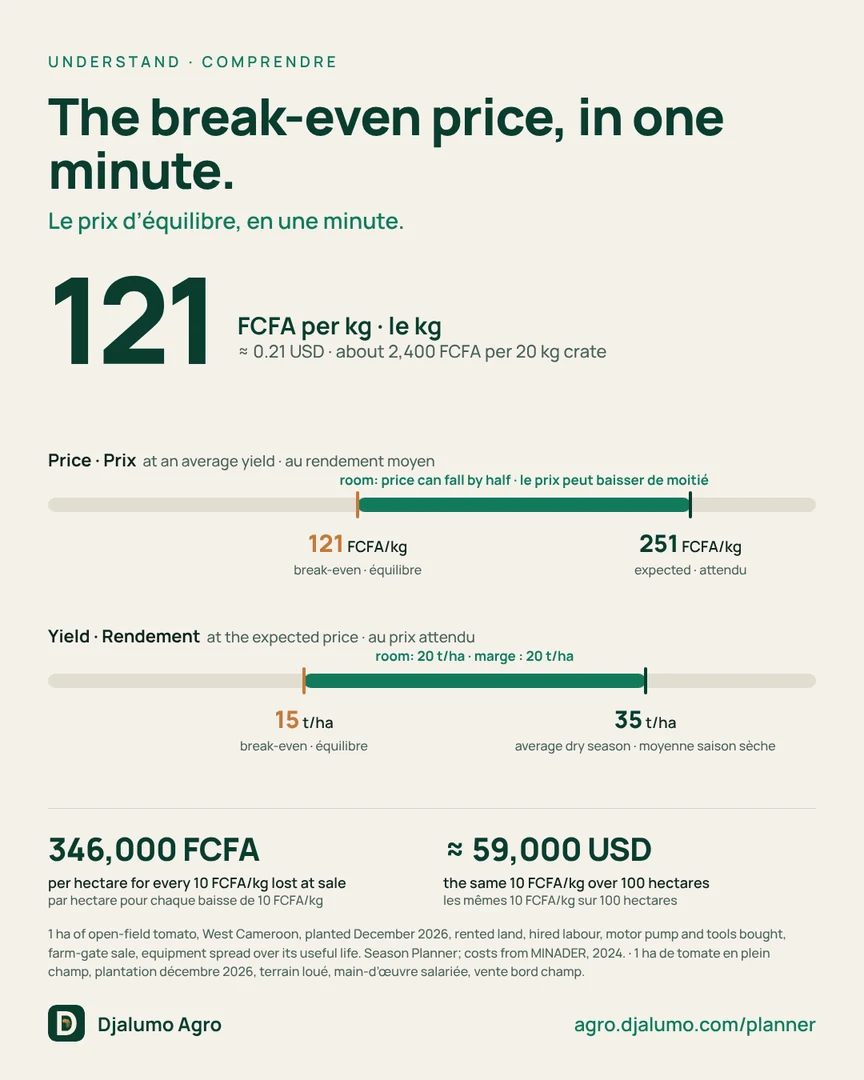
On one hectare of tomato, fertiliser and manure cost about 1.42 million FCFA in our plan. Over 100 hectares, some 142 million FCFA (about 243,000 USD) rest on a recommendation a soil test can confirm. At that scale, a soil survey belongs in due diligence, next to the land title and the water source.
Growers and agronomists: when did a soil test last change what you put in the ground?
Sources
- Cameroon Tribune, 2 October 2026
- African Union, Africa Fertilizer and Soil Health Summit, 2024
- Hengl et al., African soil properties and nutrients mapped at 30 m, Scientific Reports, 2021